Background
Cristina is a young woman who lives with her family in Massachusetts. Cristina is a self-advocate and an author and is passionate about using poetry to share her experiences. She describes herself as creatively intuitive, using writing as a tool to process and communicate with others. Cristina’s work is recognized internationally, and she has published works in English and Spanish.
What’s Important
From an early age, Cristina knew she had a quick mind and was motivated by her desire to prove herself. Cristina faced challenges through her early years of education because many of the people around her made assumptions about her ability. Cristina did not often use verbal speech to communicate in the early years of her life, which led to assumptions and misunderstanding about the types of services and supports she needed.
With appropriate supports in place, she excelled in her classes, especially on writing assignments. Cristina found her communication and ability to process information through her love for writing and music. Her passion for the arts developed from an early age and led her to further her education, completing both a bachelor’s degree and a Master of Fine Arts in creative writing. Cristina shared about her experience in higher education:
I found that in higher education [with a targeted writing focus], I was better at performing than I was at performing in worksheets or anything else, because it was my own work. It was my own writing, my own stuff. I was able to yield more, give more, be more in my fields of interest.
She went on to talk about how her postsecondary education helped shape her long-term goals by giving her a clear focus after completing her required general education courses. “I literally got the school-equals-freedom mentality and got those classes out of the way and then went straight to what I could actually do. And what I could actually have a career in.”
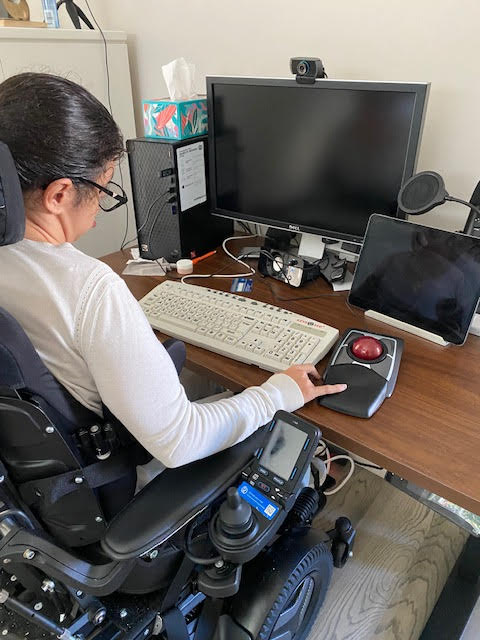
In 2019, Cristina asked her family to move to Massachusetts to truly start her career as an author. She knew Massachusetts to be a historical writer’s environment and an “author-centered state.” Cristina’s brother and their parents are all entrepreneurs and have converted their home so they each have an office to work from. Recognizing that her quadriplegia made it physically difficult to work the typical eight hours a day, Cristina created a home space and designed a schedule to pursue her writing.
After relocating to a new home, the focus was on creating a space that would support Cristina in her work as an author, advocate, and speaker. Using technology and with funding from Massachusetts Easterseals, the family converted the home into a “smart house” as Cristina calls it, with voice-activated assistants in every space. The use of technology gave Cristina supports to manage her computer-based tasks that make up most of her work time, such as writing and videoconferencing. “This became a sustainable job through technology and through actual making of the smart house,” shared Cristina. She also spoke to this home office environment giving “formality to the job.”
Cristina’s main passion is writing, but she also is paid for her disability advocacy work. Cristina shares her experiences as a self-advocate in different forums, such as podcasts, radio shows, and invited speaking engagements. Cristina has received awards and accolades for her work as an advocate, and she mentions that this recognition is part of how she measures her career growth:
I’m getting stipends, I’m getting recognized for advocacy, I’m getting awarded…those kind of accolades. Now, the work is not about those kind of accolades, but neither does it go unnoticed or unappreciated. In being recognized like that, I know I’m doing good work.
In 2019, Cristina was the featured speaker on a radio show, and as a result, she got connected to the Leadership Education in Neurodevelopmental and related Disabilities (LEND) program at Boston Children’s Hospital. She completed the LEND fellowship and found additional natural supports and mentorship as a self-advocate and a writer.
What Happened
Cristina published four books in print and digital formats between 2020 and 2024, and she is currently working on her fifth book. After her first poetry book’s release, Cristina’s editor and mentor reviewed her other manuscripts that documented her personal experiences through biographical poems on disability. With her mentor’s encouragement, Cristina published her second poetry book, which merged her passion for poetry and self-advocacy in English and Spanish. Cristina went on to publish another bilingual poetry collection in 2023, and a multilingual literary project in 2025.
In 2025, Cristina received a state-level award, recognizing her for her literary and interdisciplinary creative work. Cristina was also an invited speaker at an international university, where she presented about her lived experience as a disability advocate and published author. Cristina views these opportunities as a measure of her career advancement, stating: “I was doing these high-level presentations in the university settings that I wanted to do in the first place. That’s how I know I’m progressing.”
She acknowledges that her path to becoming an author and advocate has been challenging, and she attributes her success to her family’s high expectations and continued support. “A key factor was and always will be that my family has always seen me as a whole person.” Her family served as her “front-line advocates” throughout her childhood, and Cristina’s mother still helps her connect with her mentors and other people in networking settings.
Technology has provided Cristina with the supports she needs to effectively do her job and advance over time. Most of Cristina’s time is spent at her computer, primarily writing, but also virtually meeting with others as an advocate and promoting her books. Cristina said, “I only go out for reading and speaking gigs, and presentations.” Even in these spaces, Cristina uses technology for support. Each of Cristina’s published works is available digitally, which allows her to use an iPad for readings. Cristina’s next goal is to create a “universal book” produced in different formats for readers, including an audiobook version.
Cristina emphasizes for other families of children with communication challenges to “find your communication, don’t find your voice.” From her lens as an artist, she went on to say:
Being verbal is kind of overrated. If you’re verbal, you’re just like everyone else. But if you communicate in a different way—if you talk, do art, do theater, voice acting, or do whatever art you do, you’re communicating to people in another way that reaches people better than just straight conversation can.
Lessons Learned
Education can be a pathway for long-term career goals. Cristina recognized her passion for writing and pursued additional education after high school to focus on developing her writing skills. Exploring postsecondary education may make sense if you have a clear passion or goal for a career pathway. Talk with your support circle about the different options that exist, like college courses, degrees, and internships that may open the door to a long-term career.
Technology is a tool that can promote independence and success. Cristina turned her home into a “smart home,” embedding virtual, voice-activated assistants to support her while she works from home. This technology makes it easier for her to navigate virtual meetings and schedule her day based on her various tasks. Think about the ways you currently use technology and if added features or tools could give you more support. Technology can help us with better access, time management, and organization.
A strong support network is key. Cristina’s family and mentors were supportive and encouraged her to push boundaries. They presumed competence and emboldened Cristina to explore her passions. Her family even moved to a new state to support Cristina’s writing goals. A network of people around you who see your value and understand how they can support you is a great help in attaining, maintaining, and growing in your work.
For more information, contact: Jean Winsor at Jean.Winsor@umb.edu