Background
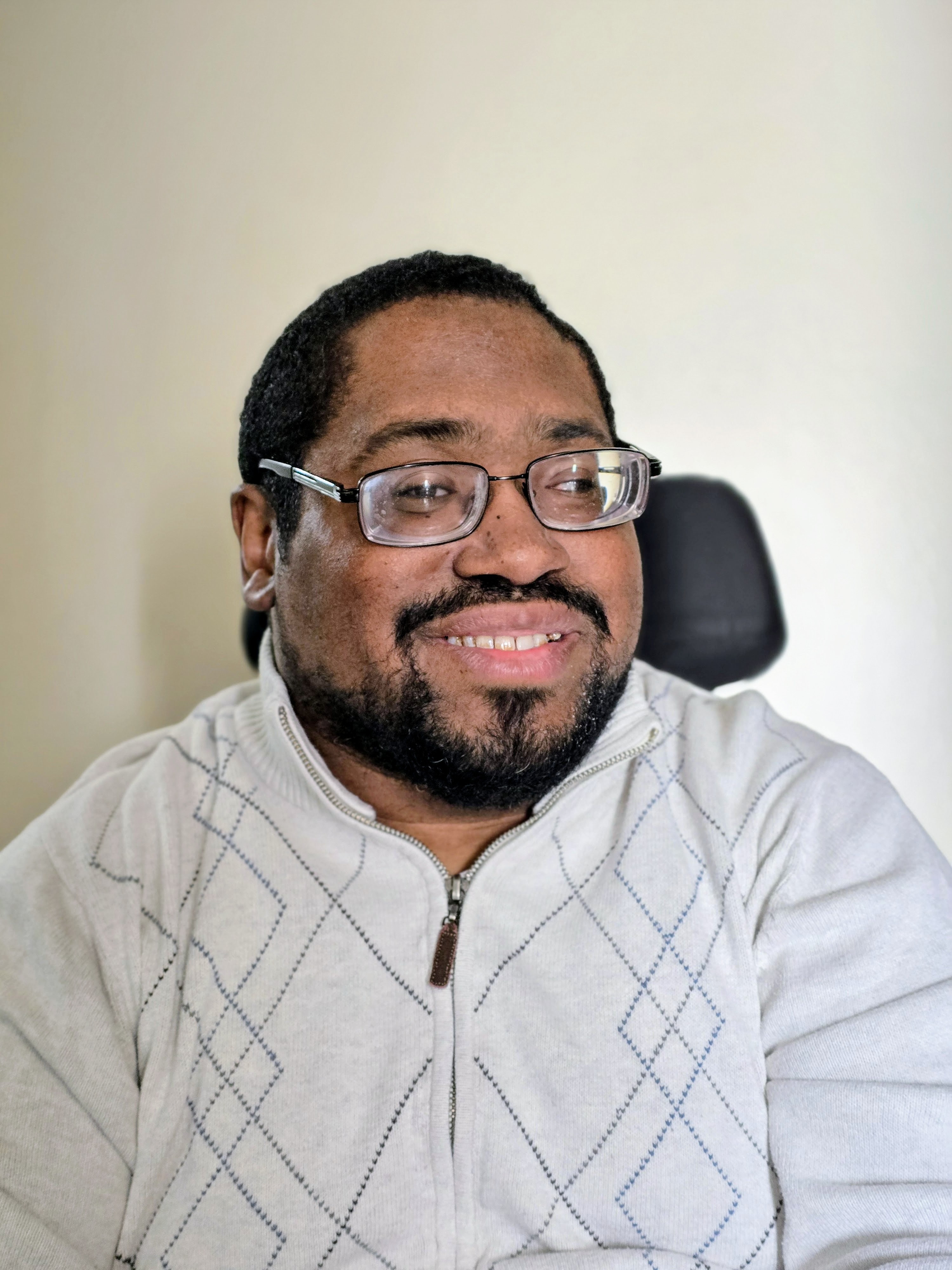
Nathan, who goes by “Nate,” is a 37-year-old man who lives in Ohio. Nate identifies as a person who lives with cerebral palsy. He has drawn on his lived experiences to elevate the voices of the disability community. Nate works for the Ohio state government supporting adults living with disabilities through outreach and education initiatives. As part of his work, he coordinates a newsletter and hosts a podcast to highlight stories of people with disabilities and available resources. Nate is passionate about engaging with others and spends his free time traveling, visiting cafes and museums, and reading. Nate lives independently, renting a two-bedroom home with his cousin.
What’s Important
Nate received support from Opportunities for Ohioans with Disabilities Bureau of Vocational Rehabilitation (VR) to help pay for his schooling, provide job development, and get assistance in finding employment opportunities after college. During his time as a college student, Nate was a member of the student government. While he had waiver services, Nate was able to rely more on natural unpaid supports and worked part-time in the Office of Disabilities Services. After college, Nate again worked with natural supports in flexible, part-time positions in customer service and administrative roles.
From there, through leveraging his job development services, Nate found a position as a freelance human data annotator, supporting third party companies to analyze and label datasets. Nate worked fully remote, set his own schedule, and continued that work for nearly eight years. He found that the position’s flexibility was helpful as he moved out on his own and managed his medical needs.
Nate has always felt a sense of control over his services due to Ohio’s independent provider model, which allows him to hire his own staff within his Home and Community-Based Services Waiver. Every waiver recipient has free choice of their provider. Ohio has many certified independent providers to choose from in addition to the option of working with an agency. Nate implemented his own layered interview process to screen candidates and move forward with those who seemed like a fit. While the self-directed model was not available in Ohio at the time he needed services, Nate explained that he had similar authority over his services:
“Ohio uses independent providers, so it feels like a self-directed relationship, because I'm able to work directly with the provider, although I don't have to navigate and don't have the option to navigate budget authority and employer authority.”
Once participant-directed services were established in Ohio, Nate began using self-direction for transportation to support his community engagement and travel for work. His ability to self-direct allowed him to work with a local car dealer he had a relationship with, set a clear budget, and purchase his own accessible vehicle. Nate shared that accessible transportation is a barrier for so many people with disabilities and that being able to manage his transportation independently was one of the most important decisions he has ever made, both personally and professionally: “[Transportation] is one of the biggest unmet needs that Medicaid systems struggle to meaningfully address, to get people living with disabilities where they want to go, when they want to go there.”
What Happened
Nate’s work and community-based experiences led him to his current job with the state of Ohio, supporting outreach and education among the disability. Nate is doing work he loves and getting paid competitively. Nate’s job duties include engaging others through presentations and podcasting, connecting people with disabilities and their families to resources, and teaching self-advocacy skills.
Nate continues to have flexibility to work from home and adjust his hours to accommodate his personal care needs. His support staff at home help him to maintain a routine so that he can keep up with the demands of having a full-time job. He also works with a job coach, who ensures he has the assistive technology necessary to accomplish his tasks. Nate continues to use traditional models of service delivery, working with independent providers for his home-based support and with VR for his job coaching services. Nate self-directs his transportation, having his paid staff drive him in his personal vehicle. He spoke to the benefit of self-direction in his life – and for others:
“I really think that the premise of self-direction is really a lifeline for the disability community. [Self-directed services] gives us the opportunity to have more choice and control in our lives. I think a lot of things happen to us because of our circumstances, but self-direction gives us the opportunity to be planful and make things happen for ourselves... I think everybody is capable of self-direction, and everybody deserves the opportunity.”
Nate also reflected on the barriers that exist to shift all his services to the participant-directed model, stating: “Now participant-directed services are available, but I think making the shift for an existing provider is difficult. So, I think if I were to need another provider, maybe I'd work to self-direct with that provider.” He acknowledged that it is not a matter of him not wanting to use self-direction, rather that there are barriers for his current providers to be approved as vendors: “It's not that I don't want to self-direct, but the hurdle of getting an existing provider established with the FMS [Financial Management Services], you know, wouldn't be worth it.” For Nate, the ability to blend service models allows him to maximize his decision making and independence, while staying focused on things that matter to him.
When asked about what he wants other individuals with disabilities to know based on his experience with self-directed services, Nate said:
"My advice [to others] is to not be afraid to ask questions. Don't be discouraged if it doesn't go the right way the first time, you're going to learn from your experiences and get better each time, as long as you commit to being clear to yourself with open communication and a willingness to try."
Lessons Learned
Service models can be blended. Services are not “one size fits all,” and the option of using more than one service delivery model can cater services to individual needs. In Nate’s case, he uses self-direction for his transportation services, traditional model for his rehabilitation technologist at work, and independent providers for his homemaker and personal care supports. Service delivery models can be combined to reach the level of support and autonomy that feels right for each person.
Self-direction is possible with the right supports. Nate referred to self-direction as a lifeline for people with disabilities, offering them the opportunity to be planful and have control over their lives. The process requires open communication, asking questions, and learning from experiences. With the right support and knowledge of available resources, self-direction can be beneficial and help address inequities.