Background
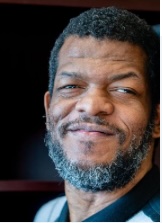
Ski is a man who lives in the Midwest. He has two degrees, one in accounting and another in elementary education with an emphasis on assistive technology. He enjoys going out to eat, and he is a voracious reader with 200 titles in his Audible app library. Ski works as an assistant researcher at a university. He uses an augmentative and alternative communication (AAC) device to speak to people.
What’s Important
Ski was always interested in assistive technology and the ways that it could benefit his own life and other people’s lives. “The two biggest challenges I had starting out were finding the right communication device and learning how to pace myself,” he shared. Ski could program a communication device to help him express his thoughts and ideas, but he struggled to find a device that worked without a lot of effort. Some earlier devices took up a lot of his energy and affected his ability to work and his motivation to communicate. However, he currently has a more user-friendly device that is better at keeping up with what he wants to say.
Assistive technology was always an element of Ski’s career success. One of his first jobs was a telework loan coordinator position with a state-run assistive technology cooperative. He learned about the opportunity through a friend and applied. He was hired and worked for the cooperative helping people with disabilities secure assistive technology loans to start businesses or work from home. “Some of my duties included working with applicants to assist them in completing the loan application, developing relationships with community partners, and community outreach,” Ski explains. This was a full-time job that included some business travel. His employer provided several accommodations, including a flexible work schedule, extra time to complete assignments, help with purchasing his communication device, paying for his direct support worker to travel on business trips with him, and being flexible about where he could work.
Ski’s other work experience was self-employment. He started his own digital scrapbooking business called Memories Forever, offering people the service of putting their most valuable pictures together into slide shows backed by music. “The biggest challenge with my business was when people started being able to make videos on their phones,” Ski shared. Under that direct competition, Ski began looking for new opportunities and learning new skills.
Eventually, Ski found an opportunity through his professional network to volunteer on a disability-related university center’s consumer advisory committee. The university center came to know him as an advisor and later offered him his current position as an assistant researcher. Ski was also interested in teaching, and the university center’s faculty offered him an opportunity to co-teach a class for the university’s special education department.
What Happened
Ski has been working as an assistant researcher at the university center for over three years. He typically works from 10am to 2pm and is paid a similar rate to other staff in his role. His days vary depending on tasks; he may be coding survey responses one day, working with partners the next day, or working with a team to write a grant proposal. Ski says that “this work is satisfying, because it gives opportunities to use advocacy skills in different ways.”
Ski’s coworkers mainly support him by sharing information that makes it easier for him to participate fully. “My team supports me in many ways, including recording meetings, so I can go back and take notes,” he explains. “They also send meeting agendas, so I can pre-program my device to be able to fully participate.”
Ski is very motivated to support the research team he works on by looking for new ways to contribute his expertise in technology. In the past year, he has learned two new packages of coding software. Ski has found a strong connection between career advancement and finding ways of supporting his research team.
Career advancement means continuously developing my professional skills and looking for growth opportunities. I am on the lookout for new tools for my research toolbox constantly. The more tools in my toolbox, the more I can support my team. Supporting my team could lead to opportunities for doors to open for me to take the next steps.
Ski says that one next step in the future might be getting back into the classroom as a teacher since he enjoyed his earlier teaching experience. His advice to others about career advancement is about knowing what you want to do and finding a supportive team of people to help you work toward your goals. Ski had co-workers and supervisors at his job who supported him to find the right adaptations that helped him complete assignments. In Ski’s own words: “Look for something that you are good at and develop a team around you that can help you move forward.”
Lessons Learned
Learn what you are good at and move forward from there. Ski followed his own advice and developed his technology and communication skills. He dedicated time to learning new technology solutions and communication techniques to use at work. His skills have opened up new directions for him to work in a field he is excited about. Let your skills and interests show you a variety of work possibilities.
You can often advance your career by being a strong team member. Ski understood that contributing to his team would lead to his individual advancement. While looking at ways to move himself forward, he studied how his team worked together and found ways to contribute to making the team stronger and better. If you are on a team at work, learn about how the team accomplishes assignments and goals, and think of ways to learn to support your team.
Volunteer experiences can be a valuable part of career growth. Ski volunteered his time as a member of an advisory committee and was able to develop new advocacy skills and build his professional network. This volunteer experience opened the door to his part-time job and later to a teaching opportunity. Volunteering in your field of interest can help you develop necessary skills, make connections, and be a stepping-stone to paid positions that meet your long-term career goals.
For more information, contact Jean Winsor.