 Background
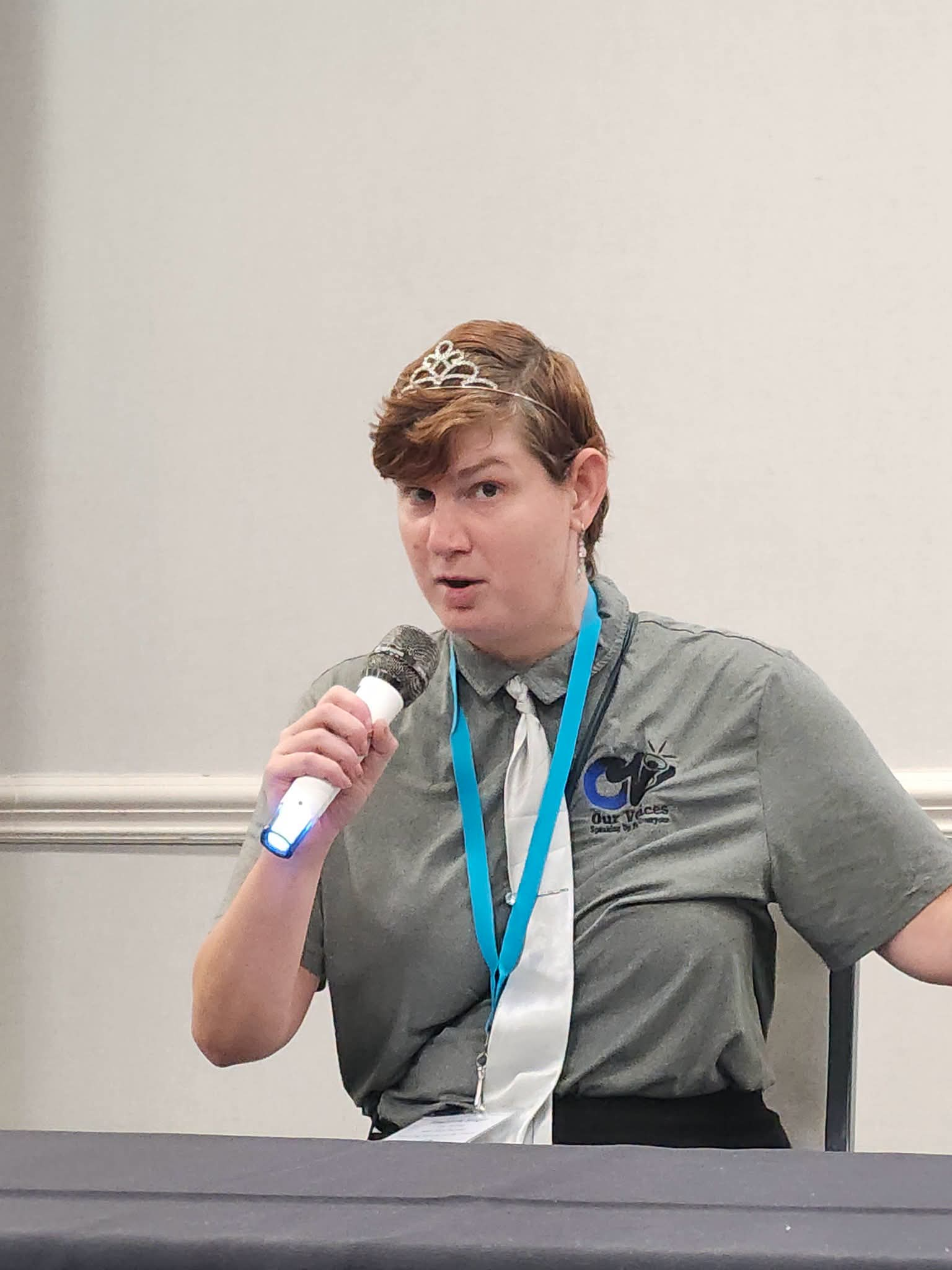
Stephanie is a young woman who lives in Virginia and works as a small group tutor in an elementary school. She has a great sense of humor and loves fashion design. Stephanie has a second-degree black belt in Taekwondo and is working on becoming the “first openly Autistic grandmaster.” She is conversational in French and knows enough Korean to navigate a basic conversation. Stephanie believes that anyone can be a hero simply by being themselves and that with the right supports, everyone is capable of achieving their goals.
What’s Important
Stephanie graduated high school with high honors and was a member of the National Honor Society. After high school, she briefly attended a workforce and rehabilitation center as she explored her next steps. She then enrolled in a community college to see if college was the right path for her. She studied liberal arts and graduated with her associate degree as a member of Phi Theta Kappa, an international honor society for high achieving students at 2-year colleges. Building on this success, she transferred to a 4-year college to study communications, where she also graduated on the Dean’s List. While in college, Stephanie gained writing experience by contributing articles to the school newspaper. She also volunteered at the botanical garden, where she helped design flyers, posters, and handbooks, and assisted with setting up and taking down conferences and other events.
The communications program required students to complete an internship. Stephanie’s academic adviser who also taught the internship course introduced her to the public relations and communications director of a local nonprofit. Stephanie shared,
When I showed [the communications director] some of the things I had created while volunteering at the botanical garden and some of the articles I had written for the school newspaper, she said, 'Okay, you're perfect. You're our new communications intern. Have fun.' She then gave me the freedom to work on designs and writing projects, some of which were published on the organization's website.
After completing her internship, Stephanie continued to do some volunteer work at the nonprofit and the CEO encouraged Stephanie to stay in touch. As she approached her college graduation, Stephanie reached out to the nonprofit to explore an opportunity for employment. Although the public relations and communications director she had worked with during her internship was no longer there, Stephanie met with the new director and shared examples of her work. She was hired as a communications specialist.
Stephanie worked three to four days a week developing stories that highlighted the experiences of individuals served by the organization, created graphics and videos, and contributed to other tasks related to writing and design projects. She also used skills gained in a digital art course in college to successfully support the organization’s fundraising efforts. She shared,
I actually produced all the creative and writing copy for their end of year campaign in 2019, and we raised double the national average for year fundraising. I had taken a digital art class in college that absolutely came in handy.
This position allowed Stephanie to use her existing skills and develop new ones. Her supervisor taught her how to use Canva and the organization supported her professional development by paying for a design course at the community college.
Stephanie used several strategies to ensure success in her role. She used a notebook to take notes during meetings. She would write down the information and check for understanding to make sure she was processing everything correctly and doing the right tasks. Stephanie also spent most of her work time at the computer and began developing headaches. She decided to get blue light glasses and found that they relieved her symptoms and that she was seeing the colors more clearly on her designs.
Stephanie shared that this job felt like family to her. Her colleagues provided her with professional and emotional support. During her time there, she was paid above minimum wage, and her hourly wage gradually increased over time. Stephanie held the position for almost nine years until an industry-wide funding decline led to the non-profit’s inability to keep her position.
After leaving the non-profit, Stephanie got another job at a call center. However, she felt that the role was not a good match for her skills and interests, and the environment was not sensitive to her sensory needs. She then started tutoring and thought to herself, “hey, I’m actually good at this.”
Stephanie followed this newly discovered employment interest and applied online for a full-time tutoring position. She interviewed and got hired as a small group tutor at an elementary school. At the time of this story’s interview, Stephanie was doing professional development courses required for her new position. Stephanie shared, “so I'm going to be working in an elementary school… I'll be being paid more than my job at the non-profit and working 40 hours a week, which is a huge jump from what I was doing at [the nonprofit].” She went on to explain why this position was a great fit for her:
I'm a great fit for this because, unlike a lot of other teachers, I remember what it's like to be that student who has the IEP and gets bullied for it. I remember what it's like to be shooting your hand up, knowing the answer, and then the teacher calls on someone else because you've given 10 answers this class period already. I know what it feels like to be that kid. A lot of teachers don't.
In her new role, Stephanie will focus on English language arts. “That's what I want to work on with these kids because that's what I'm good at.” Stephanie added, “I want to raise the next generation of communication specialists.” Stephanie will also draw on the teaching and class management skills she developed through volunteer work as a Taekwondo instructor. Reflecting on that experience, Stephanie shared, “Teaching Taekwondo as a volunteer instructor has helped me to realize what behaviors I'm going to let slide and which ones I actually have to correct in that moment, and which ones can be corrected a little bit later.”
What Happened
Over many years Stephanie held a series of different jobs, each reflecting her skill advancement. Reflecting on what career growth means to her, Stephanie said, “Growth for me is learning new skills, getting to use those skills. Seeing my work published, plastered across the internet was definitely a moment for me. Getting recognition, getting a higher pay grade, that's growth to me.” She also shared that sometimes life circumstances can result in unexpected opportunities for growth, saying, “I thought I was going to be at [the non-profit] forever and ever. Growth really wasn't on my radar. I was happy where I was at, and then I was forced to pivot.”
The main challenge that Stephanie has experienced in her education and employment journeys was low expectations from some people close to her. Her advice to others looking to advance in their career is to have high expectations for themselves and not let other people’s low expectations of them hold them back. She shared “take ownership of your life and do not let others tell you what to expect for yourself.” Her advice to family members and supporters is to have high expectations for their loved one; “don't tell someone they can't do something or they'll never do something.”
In the future, Stephanie hopes to become an assistant teacher. In her summers off, she hopes to run her own fashion design business that considers and accommodates different sensory needs.
Lessons Learned
Internships can lead to paid job opportunities. Internships allow employers to see a person's strengths and potential in a real work setting. Stephanie's experience shows that internships can help people demonstrate their abilities, develop relationships, and gain work experience that can lead to a paid position.
Transferable skills matter. Skills learned through a job, volunteer role, internship, or life experience can be applied to other areas and lead to career growth. Stephanie used skills that she developed through the courses she took in college and in volunteering for the college newspaper to thrive as a communication specialist. She also used skills gained volunteering as a taekwondo teacher for her tutoring position.
Have high expectations for yourself and others with disabilities. It’s important for individuals, family members, educators, and support professionals to have high expectations, and to focus on strengths rather than limitations. Stephanie had high expectations for herself and stayed focused. She pursued her dream of going to college and finding a job that was a good fit even after she lost her first job.
Career growth may not be linear. While Stephanie loved her role as a communication specialist and experienced growth through increased responsibilities and higher wages, she achieved even greater professional growth when she found her job as a tutor. Career growth can come from unexpected job changes or after what seems like a lost opportunity. It’s important to stay open and continue to explore opportunities when you have setbacks.
For more information, contact: Jean Winsor: Jean.Winsor@umb.edu