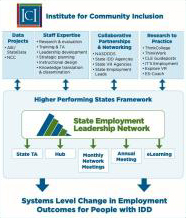
Systems Change

Developing and implementing changes to state employment services is a long-term process that requires changes to policy, practice, funding, performance measurement, and collaboration. An important part of systems change is recognizing that when a state changes one part of their system, they must make complementary changes to other parts of their system. Explore the following resources to learn how state IDD agencies have worked to implement long-term changes.

You can find more examples of systems change on the State Agency Promising Practices page.

Community Rehabilitation Providers resource page has more information about how providers can more effectively help people with IDD find and keep jobs in their community.

State Employment Leadership Network (SELN) Within a University Centers for Excellence in Developmental Disabilities (UCEDD) as a Conduit for Systems Change

publication thumbnail

Freeze, S., Winsor, J., Powers, B., Huppi, A. (2026). UCEDD Innovations Lead to IDD Networks' Driving Change: Envision, Empower, Employ. Developmental Disabilities Network Journal, 5(2) Article 23.

The State Employment Leadership Network (SELN) leverages the ICI/UMass Boston's role as a University Center for Excellence in Developmental Disabilities (UCEDD) to strengthen employment systems change for people with intellectual and developmental disabilities (IDD). ICI’s structure supports collaboration across research, technical assistance, coaching, mentoring, and policy work, helping states build capacity and better support individuals with IDD to achieve their career goals. SELN’s integration within ICI allows staff to identify emerging needs in real time, share resources quickly, and connect related initiatives across projects and partners. Together, these efforts support statewide systems change through technical assistance, networking opportunities, data-informed practices, and research-to-practice initiatives that improve employment outcomes for people with IDD. 

Read UCEDD Innovations Lead to IDD Networks’ Driving Change: Envision, Empower, Employ.


Publications


Meeting the Holistic Vision of Employment and Community Life Engagement: State Administrator Perspectives on Achievements and Gaps

As states focus on expanding integrated employment opportunities for people with intellectual and developmental disabilities (IDD) and phase out sheltered work, they are finding a need to concurrently examine day services and supports that promote Community Life Engagement (CLE, see yellow box to the right for a detailed definition). These supports can be a wrap-around to ensure individuals’ engagement in the community is maintained and they continue to receive sufficient levels of support, despite fluctuations in job status and hours.

State of the Science as a Knowledge Translation Strategy

Download full brief here or read on for summary. To synthesize our findings to date, the ThinkWork team at ICI developed 3 draft papers that captured the core themes from our RRTC on Advancing Employment for Individuals with Intellectual and/or Developmental Disabilities (IDD). We asked experts in the field to weigh in on these papers, and then broadly disseminated the papers to multiple audiences.

44 Series - What does choice really mean when we talk about employment?

  Watch the recorded video here. The 44 series is an ongoing series of webinars (each about 44 minutes long, hence the name!) that address various topics related to integrated employment for individuals with IDD. In this edition to the series, originally presented on 11/27/18, speaker Liz Weintraub discussed issue of choice and self-direction in the job search process. She focused on challenges, risk, and empowerment for job seekers with disabilities. 

State Employment First Policies #3: Investing in Training and Technical Assistance to Build Capacity in Integrated Employment

This brief is the third in a series focusing on Employment First implementation as it relates to one of the seven elements within the High-Performing States in Integrated Employment model. As states undergo implementation of their policies, it is important to understand how state agencies have built employment knowledge and capacity. Download here.

State Employment First Policies #2: Engaging Stakeholders in Development and Implementation

This brief is the second in a series focusing on Employment First implementation as it relates to one of the seven elements within the High-Performing States in Integrated Employment model. It looks at the interagency collaboration and partnership element in depth. Interagency partnership and collaboration includes interagency agreements and relationships, provider collaboration, and outreach to stakeholders to ensure that integrated employment is a shared goal.

Different states, common issues: Moving mountains one service at a time

In an ever-evolving landscape, states are working to achieve new levels of integrated employment outcomes. While state have been building supports for more than five decades to meet the needs of their constituents, a different playing field has emerged in recent years. This is a result of new regulations, requests from advocates and families, shifting expectations and fluctuating state budgets. How are states managing the range of large and small changes needed to update the employment and employment-related service definitions that are offered? How can we ensure connection between employment and other full life outcomes? And most importantly, how can stakeholders establish individual integrated employment as a priority goal?

Research to Practice: State Employment First Policies: State Definitions, Goals and Values

This brief is the first in a series focusing on Employment First implementation as it relates to one of the seven elements within the High-Performing States in Integrated Employment model. It examines the background of circumstances under which Employment First efforts began in seven states, and introduces each state’s values, mission, and goals around increasing employment opportunities for people with disabilities. States may use the lessons in this brief to develop an Employment First policy, or to evolve existing efforts.