Systems Change
Developing and implementing changes to state employment services is a long-term process that requires changes to policy, practice, funding, performance measurement, and collaboration. An important part of systems change is recognizing that when a state changes one part of their system, they must make complementary changes to other parts of their system. Explore the following resources to learn how state IDD agencies have worked to implement long-term changes.
You can find more examples of systems change on the State Agency Promising Practices page.
Community Rehabilitation Providers resource page has more information about how providers can more effectively help people with IDD find and keep jobs in their community.
Freeze, S., Winsor, J., Powers, B., Huppi, A. (2026). UCEDD Innovations Lead to IDD Networks' Driving Change: Envision, Empower, Employ. Developmental Disabilities Network Journal, 5(2) Article 23.
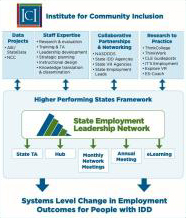
The State Employment Leadership Network (SELN) leverages the ICI/UMass Boston's role as a University Center for Excellence in Developmental Disabilities (UCEDD) to strengthen employment systems change for people with intellectual and developmental disabilities (IDD). ICI’s structure supports collaboration across research, technical assistance, coaching, mentoring, and policy work, helping states build capacity and better support individuals with IDD to achieve their career goals. SELN’s integration within ICI allows staff to identify emerging needs in real time, share resources quickly, and connect related initiatives across projects and partners. Together, these efforts support statewide systems change through technical assistance, networking opportunities, data-informed practices, and research-to-practice initiatives that improve employment outcomes for people with IDD.
Read UCEDD Innovations Lead to IDD Networks’ Driving Change: Envision, Empower, Employ.
Publications
In concert with the Institute for Community Inclusion (ICI) at the University of Massachusetts Boston, the National Association of State Directors of Developmental Disabilities Services (NASDDDS) identified potential topical areas for policy white papers that influence employment outcomes and services for individuals served by state intellectual/developmental disabilities (I/DD) agencies. This is the third white paper in a series of five.
RRTC on Advancing Employment Composite Indicator Research
What?
Analysis to describe the relationship between state employment system characteristics and employment outcomes for individuals with intellectual and developmental disabilities (IDD).
Why?
To better understand higher-performing state employment systems.
State Employment First Policies #1: State Definitions, Goals and Values
This brief is the first in a series focusing on Employment First implementation as it relates to one of the seven elements within the High-Performing States in Integrated Employment model. It examines the background of circumstances under which Employment First efforts began in seven states, and introduces each state’s values, mission, and goals around increasing employment opportunities for people with disabilities.
A Purpose in Life: Why Employment First Matters to Self-Advocates
Self-advocates with intellectual disabilities describe Employment First efforts in their states, and why those efforts are important.
Episode 3: A Blueprint for Employment Success in Massachusetts
Margaret Van Gelder is the director of employment and family support at the Massachusetts Department of Developmental Services, or DDS. In this conversation, Margaret talks about the Massachusetts Blueprint for Success, and what competitive employment has meant for job seekers and employers.
Episode 2: Leadership and Collaboration in Maryland
In this episode, we chat with Jade Gingerich from the Maryland Department of Disabilities, the nation’s only cabinet-level agency dedicated to all disabilities.
Episode 1: Work-Based Learning in Tennessee
In our first episode, Anya Weber from the ThinkWork team interviews Blake Shearer from the Tennessee Department of Education. Blake directs the state’s work-based learning initiative for special populations. On the podcast, he discusses the importance of teacher leadership, and shares strategies that are leading to successful employment outcomes in Tennessee.
State of the Science Paper – State level strategy and policy
This brief covers Strand 4: Policies and Practices of High-Performing State Employment Systems. Download the brief here.
Community of Practice on Demonstration Projects: Collaboration and Systems Change
Beginning in FY 2012 and 2013, the Administration on Intellectual and Developmental Disabilities (AIDD) funded eight Partnerships in Employment (PIE) systems change projects under the Projects of National Significance program. PIE is a national transition systems change project whose purpose is to identify, develop, and promote policies and practices to improve transition, post-secondary, and competitive employment outcomes for individuals with intellectual and developmental disabilities (IDD).
APSE Employment First Statement
Read the statement here. These authors worked together to write a statement about what Employment First means and why it’s important.