Systems Change

Developing and implementing changes to state employment services is a long-term process that requires changes to policy, practice, funding, performance measurement, and collaboration. An important part of systems change is recognizing that when a state changes one part of their system, they must make complementary changes to other parts of their system. Explore the following resources to learn how state IDD agencies have worked to implement long-term changes.

You can find more examples of systems change on the State Agency Promising Practices page.

Community Rehabilitation Providers resource page has more information about how providers can more effectively help people with IDD find and keep jobs in their community.

State Employment Leadership Network (SELN) Within a University Centers for Excellence in Developmental Disabilities (UCEDD) as a Conduit for Systems Change

publication thumbnail

Freeze, S., Winsor, J., Powers, B., Huppi, A. (2026). UCEDD Innovations Lead to IDD Networks' Driving Change: Envision, Empower, Employ. Developmental Disabilities Network Journal, 5(2) Article 23.

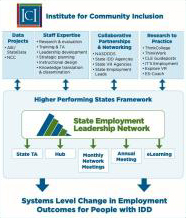
The State Employment Leadership Network (SELN) leverages the ICI/UMass Boston's role as a University Center for Excellence in Developmental Disabilities (UCEDD) to strengthen employment systems change for people with intellectual and developmental disabilities (IDD). ICI’s structure supports collaboration across research, technical assistance, coaching, mentoring, and policy work, helping states build capacity and better support individuals with IDD to achieve their career goals. SELN’s integration within ICI allows staff to identify emerging needs in real time, share resources quickly, and connect related initiatives across projects and partners. Together, these efforts support statewide systems change through technical assistance, networking opportunities, data-informed practices, and research-to-practice initiatives that improve employment outcomes for people with IDD. 

Read UCEDD Innovations Lead to IDD Networks’ Driving Change: Envision, Empower, Employ.


Publications


Delphi Panel Findings #4: Education and Training for Job Seekers

This is the fourth in a series of briefs on the findings from a Delphi process conducted by the Employment Learning Community in 2013–2014. More information on the Employment Learning Community and the Delphi process can be found in Brief #1 (Introduction, Values, and Overall Themes). This brief focuses on the role of education and training for job seekers with intellectual and developmental disabilities (IDD), which was the third-ranked overarching priority among the Delphi panel members.
Delphi Panel Findings #3: Collaboration Across Agencies

This is the third in a series of briefs on the findings from a Delphi process conducted by the Employment Learning Community in 2013–2014. More information on the Employment Learning Community and the Delphi process can be found in Brief #1 (Introduction, Values, and Overall Themes). This brief focuses on the panel’s recommendations related to collaboration across state systems, which was the second-highest overarching priority identified by the Delphi panel for improving employment outcomes for people with intellectual and developmental disabilities (IDD).

Delphi Panel Findings #2: Transition from School to Work

This is the second in a series of briefs on the findings from a Delphi process conducted by the Employment Learning Community (ELC) in 2013–2014. More information on the ELC and the Delphi process can be found in Brief #1 (Introduction, Values, and Overall Themes). This brief focuses on the panel’s recommendations related to effective approaches to the transition from school to work for youth with intellectual and developmental disabilities (IDD), which was the highest-ranked overarching priority among the Delphi panel.

Delphi Panel Findings #1: Introduction, Values, and Major Themes

The Employment Learning Community (ELC) is an Administration on Intellectual and Developmental Disabilities-funded project that promotes systems change to improve competitive employment outcomes for individuals with intellectual and developmental disabilities (IDD). The ELC’s primary activities are technical assistance and peer-to-peer networking and information sharing through Communities of Practice (CoPs). Through a competitive process, seven states were selected as members of the ELC: District of Columbia, Idaho, Kentucky, Maryland, Minnesota, New Hampshire, and North Dakota.

Working Together: Collaboration between Colorado’s Developmental Disabilities Division and Division of Vocational Rehabilitation

In Colorado, counselors from the Division of Vocational Rehabilitation are housed on-site in Community Centered Board offices so they can provide direct services to individuals with intellectual and developmental disabilities (ID/DD). The goal of the project was to serve 240 customers with ID/DD and provide 134 successful employment outcomes over a two-year period. Streamlined services and enhanced communication emerged through a unique collaborative effort between the two entities.

The Tennessee Employment Consortium (TEC): A Statewide Collaboration for Change

The Tennessee Employment Consortium (TEC) is a statewide organization focused on increasing the number of Tennesseans in integrated employment. The consortium comprises volunteers from the state's Division of Mental Retardation Services (DMRS) and Division of Rehabilitation Services (DRS), the Tennessee Council on Developmental Disabilities, the ARC of Tennessee, the Center on Disability and Employment at the University of Tennessee, community rehabilitation providers (CRPs), family members, and other stakeholders.

Iowa's Governance Group: Facilitating Partnerships That Support Integrated Employment

1998, five state agencies formed the Governance Group. Partner agencies included: Iowa Workforce Development, Department of Human Services, Department of Education, Iowa Vocational Rehabilitation Services and Department of Human Rights. The group was developed in response to a Rehabilitation Services Administration (RSA) request for proposals that included an advisory group for systems change efforts to expand employment opportunities to individuals with disabilities.

Colorado's Ad Hoc Committee on Employment and Community Participation

The Ad Hoc Committee on Employment and Community Participation began meeting in the winter of 2004 in an effort to promote integrated employment opportunities for people with disabilities in Colorado. The committee was comprised of representatives from the Division for Developmental Disabilities (DDD) administration; the Division of Vocational Rehabilitation; local Community Centered Boards (private nonprofit organizations responsible for authorizing services); advocacy groups; and self-advocates, parents, and service providers.

State Employment Practices: Funding for Employment Services

As state developmental disability service systems strive to balance myriad challenges, the inevitable question of funding must be addressed. Through State Employment Leadership Network (SELN) events, member states have regularly expressed the need for additional analysis and insights related to rates, reimbursement, and funding issues. This series of Funding Summaries is intended to shed light on the complexities as well as successes experienced by state systems across the country.